You Cannot Install a Human System
By Carol A. Grojean, Phd
Leaders keep announcing transformation and wondering why no one moves. What ancient rites of passage and new neuroscience reveal about how humans actually change.
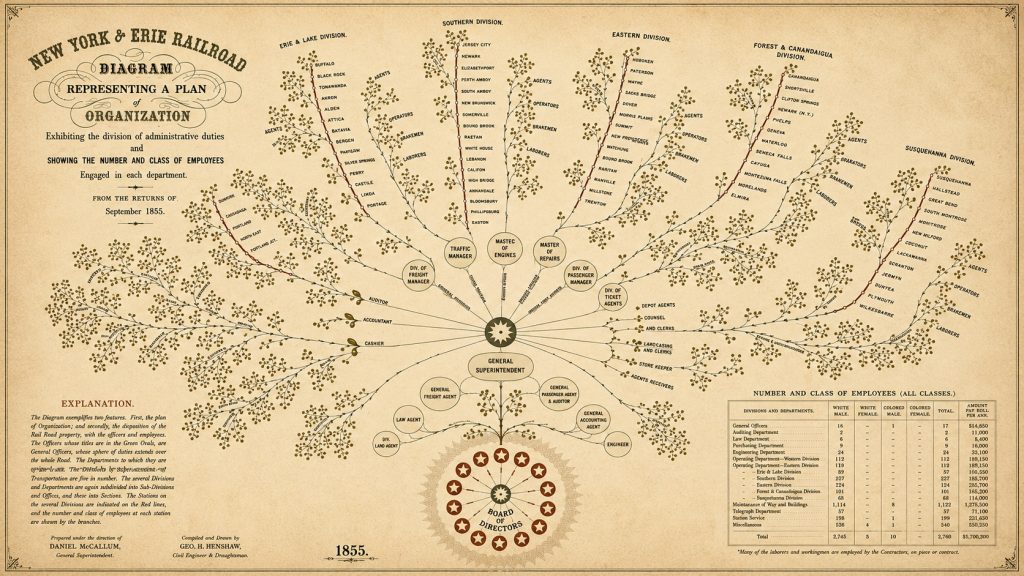
The first modern org chart, 1855. Notice that McCallum drew the company as a living tree. We have spent 170 years turning it back into boxes.
We keep trying to install change the way we install software. We push the update in a team meeting, we send the release notes in an email or worse, on an org website, then we hold the all-hands where we put our new goals on a slide, talk about our cultural values, and set big aspirations for the future with AI. Then we wonder why no one knows how to cross this threshold.
You see, we are asking people to change faster than at any point in organizational history, yet nothing about how we lead this change is any different than the first org chart drawn up in 1855. And that basic visual grammar has barely changed in 170 years: authority → hierarchy → reporting → responsibility → control.
You see the org chart may be one of the earliest technologies through which we reduced a living social system to a representation of its formal structure, and in that movement we forgot how to help humans move through times of disruption and transformation.
Deloitte just put a number on the cost. In its 2026 Global Human Capital Trends report, 65% of organizations say their culture needs to change significantly because of AI. Only 5% say they are making real progress on it. Deloitte calls the space between those two numbers culture debt: the accruing cost of leaving trust, fairness, identity, and human connection unresolved while the technology races ahead.
More so, Gallup shows where that debt comes from. 93% of Fortune 500 HR chiefs say they have already begun integrating AI. Barely a third of their employees have noticed, and only 15% say their company has clearly communicated a plan for it. The technology gets installed at the top and announced to the middle, and almost no one is helped across. That is not an adoption problem. It is a crossing that never happened.
This is because culture cannot come about through what any leader says, only through the actions they take and what they pay attention to. Meaning culture is what a team learns about reality through repeated experience. What happens when I tell the truth here? Who actually gets heard? What am I worth now that a machine can do part of what made me valuable? Those are not technology questions, and AI is making these questions more relevant every day.
Deloitte also found that 80% of leaders and workers now worry their colleagues are using AI to appear more productive than they really are. Sit with that one. It’s a trust problem wearing a productivity costume. Busyness has always been incoherence dressed as output, and AI lets a team stitch the costume faster than ever.
So I keep coming back to something humans have understood for tens of thousands of years and our modern culture has progressively paved over as unimportant. That humans need a structured way to move through change, individually and collectively, to help them shift from one way of being to a new way.
We used to call these things Rituals. Rites of passage. Ceremony. These meaningful thresholds are how a community crosses from one identity into another and knows, in the body, that it has crossed.
The science is catching up to what the elders already knew. When people move through ritual together, attention converges, speech rhythms align, and their physiology begins to couple. Heart rhythms move in step. In studies of collective ceremony, shared arousal and synchronized movement raise cohesion and cooperation. Something measurable happens when a group crosses a threshold as one.
Here is what most leaders miss, and it matters more than any of it. Synchrony is not harmony. A team can synchronize around fear, or urgency, or a bad idea everyone is too tired to question. More alignment is not automatically better alignment. The point was never to make everyone the same. It’s to build enough shared reality that difference becomes useful instead of fracturing the system. You paid for the range of minds on your leadership team. Coherence is how you finally collect the return.
Which is exactly why ritual and measurement belong in the same sentence, though we almost never put them there. One lets a team experience a transition. The other lets a leader see what is actually happening underneath it.
For most of history, leaders had only intuition to sense whether a team was connected or quietly coming apart. That’s changing, and it’s the work I do. I use an AI-powered social neurotechnology platform, Syneurgy, to read the human system the way a performance engineer reads a digital one: the behavioral, cognitive, and physiological signals of whether a team is genuinely coordinating or only appears to agree. My own diagnostic, the Leadership Coherence Index, holds the other half up against it, what the team believes about itself. The gap between the two is the whole game.
It lets a leadership team stop asking only how aligned we feel, and start asking sharper questions. Is attention converging, or fragmenting? Does regulation hold under pressure, or fall apart? Do we decide cleanly, or keep relitigating the settled question?
We have learned to measure and engineer the performance of the digital system. I measure and engineer the performance of the human system, the culture. Same rigor, one layer down. It is the leading indicator underneath every KPI, OKR, and NPS you already track.
This is why I don’t believe the next era of transformation gets won with a better communications campaign or a sharper values statement. It gets won by designing better human crossings. We are asking leaders and teams to cross threshold after threshold now. From human work to human-and-AI work. From expertise to augmentation. From certainty to continuous adaptation. Humans have always needed a way to cross a threshold together, and we have quietly stopped building the container for it.
And it starts with the leader, not the team. A regulated nervous system is contagious. So is a dysregulated one. A leader cannot occasion a crossing they have not made themselves. In the old rite of passage, the elder had already walked into the fire and come back, and that is the shift I watch leaders make now: from sponsor and change-agent to guide, midwife, elder, fire keeper. You have to cross the fire before you can keep it for others.
From there the work has an arc. The capacity to stay present when it matters most, because a regulated leader is the one a team organizes around. A clear and honest orientation to what is really happening. The structures and rhythms that make the new way workable. Then, sometimes, a real threshold: the moment a team stops performing the old identity and chooses, together, what it is becoming. And finally the integration that makes it hold.
AI is accelerating the transformation of work. The deeper transformation is human. The question is no longer only how fast an organization can adopt the technology. It is whether it can stay human, and coherent, while it does.
The leaders who shape what comes next will be the ones who understand that transformation is not finished when the new system goes live.
It is finished when the team has crossed the threshold together.
About Carol Grojean, PhD:
Carol A. Grojean, PhD, is a social systems scientist, writer, speaker, and leadership advisor exploring what it means to be human in an age of accelerating technology. She holds a PhD in Transformative Social Change, three master’s degrees, and an ICF coaching certification, and has led billion-dollar transformation initiatives for global organizations, advised executives and governments on AI and organizational transformation, and guided leaders in developing the human capacities essential for navigating complexity. Her work is further informed by years of direct study and participation in developmental, contemplative, and ceremonial traditions across cultures. Through the Coherence Method™ and the Leadership Coherence Index™, which she delivers in partnership with Syneurgy, whose AI-powered social neurotechnology platform detects signals of team synchrony that engagement surveys cannot, she makes coherence measurable rather than merely felt, helping leaders and organizations move from fragmentation to coherence, enabling clearer thinking, stronger alignment, and more effective leadership in the age of AI.